How Enterprise Teams Operationalize AI Visibility
Enterprise AI visibility is not just "run more reports." It is multi-brand tracking, cross-team workflows, stakeholder reporting, and integration with your existing stack. Here is a practical rollout model.
Published Jun 2025 · Updated Mar 2026
Why Enterprise Is Different
Enterprise AI visibility is not just a bigger version of what a single brand team does. The challenges are structurally different:
Multiple brands and sub-brands. A portfolio company might need to track a parent brand, three product brands, and two regional variants — each with its own competitive set and buyer personas.
Diverse business units. Each BU cares about different personas, different competitors, and different AI models. The enterprise challenge is not "AI search seems hard" — it is what seems hard across 20 teams with different objectives at once.
Stakeholder reporting. A CMO wants a dashboard. A SEO lead wants prompt-level data. An agency partner wants exportable reports. The same data needs to serve different audiences with different levels of detail.
Governance. Who owns AI visibility? Is it SEO, brand, content, PR, or a new function? Most enterprises discover this question only after they start measuring — and the answer varies.
The Rollout Model
Based on working with enterprise teams, here is the phased approach that works:
Single-brand pilot
Pick one business unit. Define 3-5 personas for their category. Run baseline reports across all models. Goal: prove the value of AI visibility data and establish internal vocabulary. This typically takes 1-2 weeks.
Expand personas and set up monitoring
Add more personas to cover the full buyer landscape. Set up monthly scheduled monitoring. Start tracking competitive shifts and measuring the impact of content changes. This is where AI visibility becomes an operational discipline rather than a one-time curiosity.
Multi-brand rollout
Extend to additional brands and BUs. Each gets its own persona set, competitive landscape, and monitoring cadence. Cross-brand competitive data starts revealing portfolio-level insights (e.g., "Our premium brand is strong but our value brand is invisible").
Integration with existing stack
Export data to BI dashboards, marketing automation platforms, and reporting workflows. AI visibility data becomes part of the regular marketing performance review alongside SEO, paid, and social metrics.
Org Structure for AI Visibility
Who owns AI visibility? Here is the pattern we see working at enterprise scale:
SEO / Content team
Owns measurement and content optimization. Runs reports, interprets data, and recommends actions. Closest to the existing skill set required.
Brand / Marketing team
Owns messaging and positioning. Ensures AI-facing content accurately represents brand identity and differentiation.
PR / Comms team
Owns third-party presence. Drives coverage on the sources AI models cite — publications, review sites, industry platforms.
Analytics / BI team
Integrates AI visibility data into dashboards and reporting. Ensures stakeholders get the right level of detail for their role.
Enterprise Concerns Addressed
Data security
API-only access — no browser automation, no stored credentials, no access to your internal systems. Read about our methodology.
Compliance
Every model interaction goes through official APIs, fully compliant with provider terms of service. No scraping, no terms violations.
Data export
Full data export capabilities for integration with your existing BI tools, dashboards, and reporting workflows.
Cost control
Pay-as-you-go pricing scales linearly with usage. No per-seat fees, no minimum commitments. Enterprise teams control costs by scoping personas and monitoring cadence.
Multi-region
Persona localization supports regional variations — different buyer profiles for different markets, tested across the same model set.
Multi-brand
Track parent brands, sub-brands, and product lines independently — each with its own competitive landscape and persona set.
What Enterprise Teams Actually Ask Us
"How do we get buy-in from leadership?"
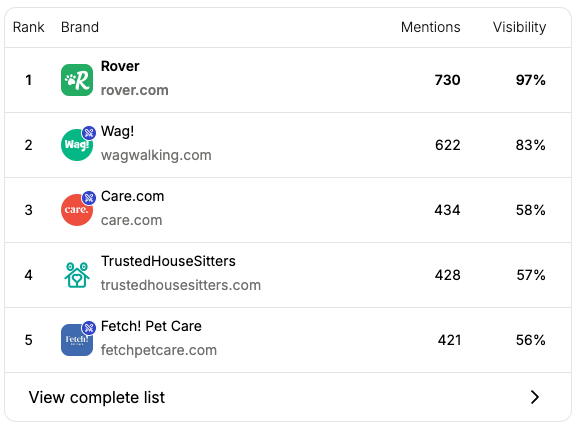
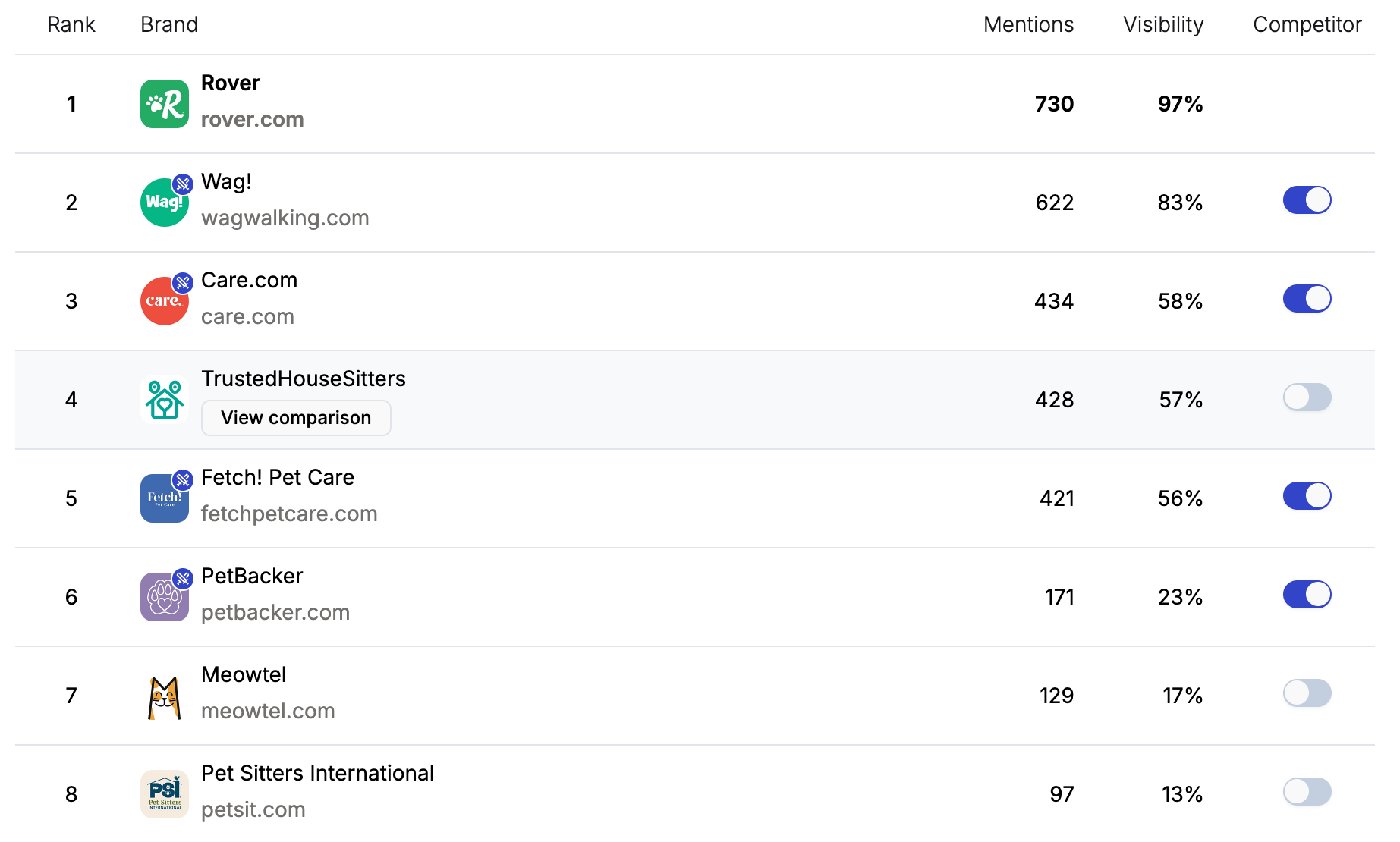
Run a free pilot report for your flagship brand. Show leadership the competitive leaderboard — when they see competitors mentioned 60% of the time while their brand appears in 12% of AI responses, the conversation shifts quickly.
"How do we staff this?"
You do not need a new team. AI visibility measurement is a natural extension of existing SEO/content roles. Start with one person running monthly reports and sharing insights. Scale the function as the data proves its value.
"What does the first month look like?"
Week 1: Run baseline reports for 1-2 brands. Week 2: Share findings with stakeholders. Week 3: Identify top 3 action items. Week 4: Begin content optimization based on gaps. Follow the GEO 101 playbook for the detailed approach.
"How does this fit with our agency?"
Many enterprise teams run Gumshoe alongside their agency. The agency gets access to the data and uses it to inform content strategy, PR efforts, and competitive positioning. Some agencies run Gumshoe independently for their enterprise clients.
Start with a pilot
Run a free report for one brand to see what AI visibility data looks like for your organization. No commitment required.
Enterprise AI visibility starts here
See how AI models describe your brands across ChatGPT, Gemini, Claude, Perplexity, and more.
Free to start · No credit card required